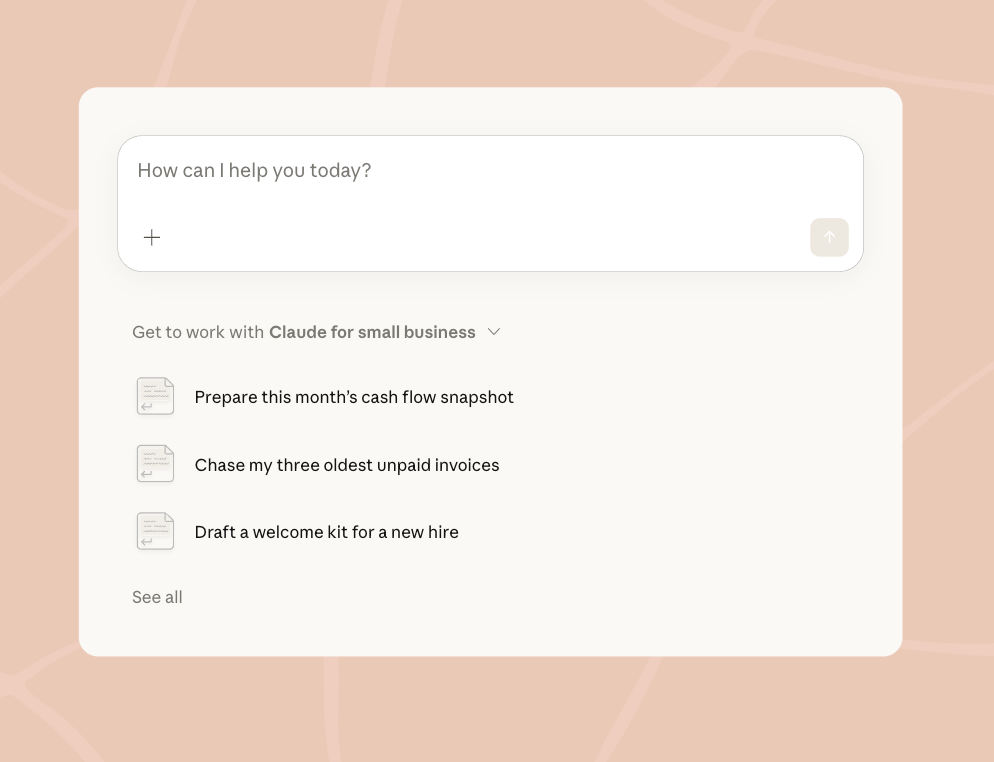
Earlier this year, Anthropic caused ripples across the SaaS world by introducing specific Claude plugins: out-of-the-box workflow solutions spanning legal, marketing, and compliance use cases. It continues to expand in these areas, this time with the launch of Claude for Small Business. Through a dedicated plugin, businesses can now access 15 pre-built workflows to help run their day-to-day operations.
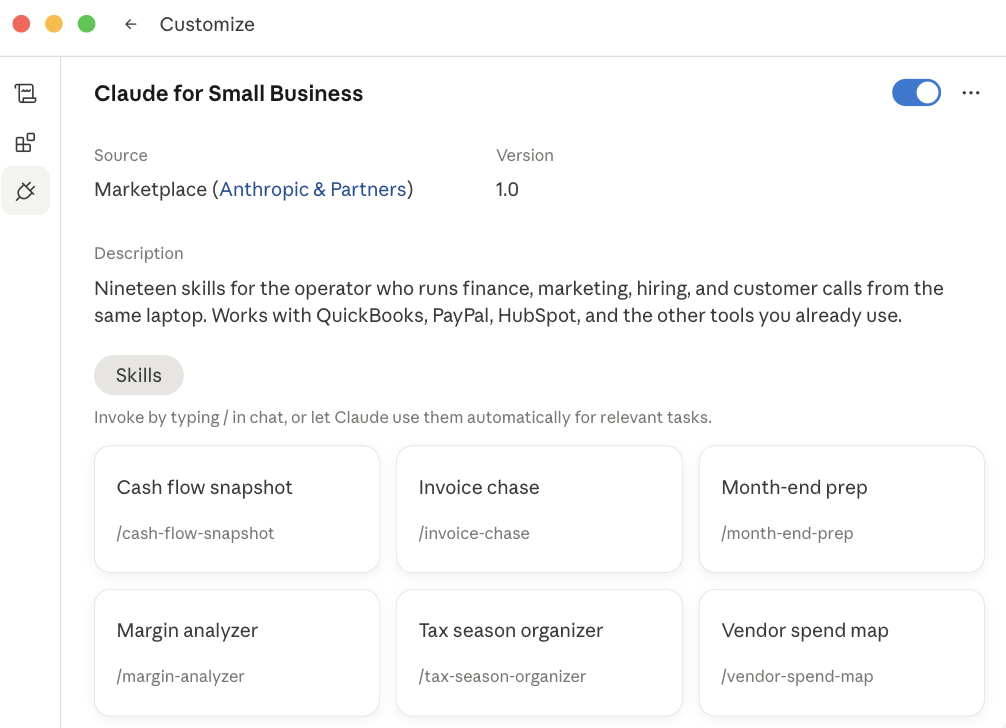
A plugin combines skills and MCP servers, enabling users to get consistent, quality output from their existing business tools. For example, you can use /plan-payroll to forecast cash and chase overdue invoices, or /close-month to reconcile accounts and generate a plain-English P&L narrative.
Small business owners and their staff can use Claude Cowork for questions and tasks such as:
- Run a business pulse for the last 30 days. Show me my cash position, overdue invoices, and upcoming bills.
- Reconcile my PayPal settlements and QuickBooks books for this month, flag what doesn’t match, and write a plain-English P&L.
- Is this contract a trap? Review the attached service agreement and list three clauses that put my small business at risk.
- Draft a firm but professional email to [Client Name] chasing an invoice that is 14 days overdue.
These pre-built workflows are enabled through connectors to the software products that small businesses already use. For example, if you ask Claude to help plan your payroll and manage cash flow, it will fetch the relevant accounts receivable and payable information via QuickBooks and transaction history via PayPal to create a cash flow forecast.
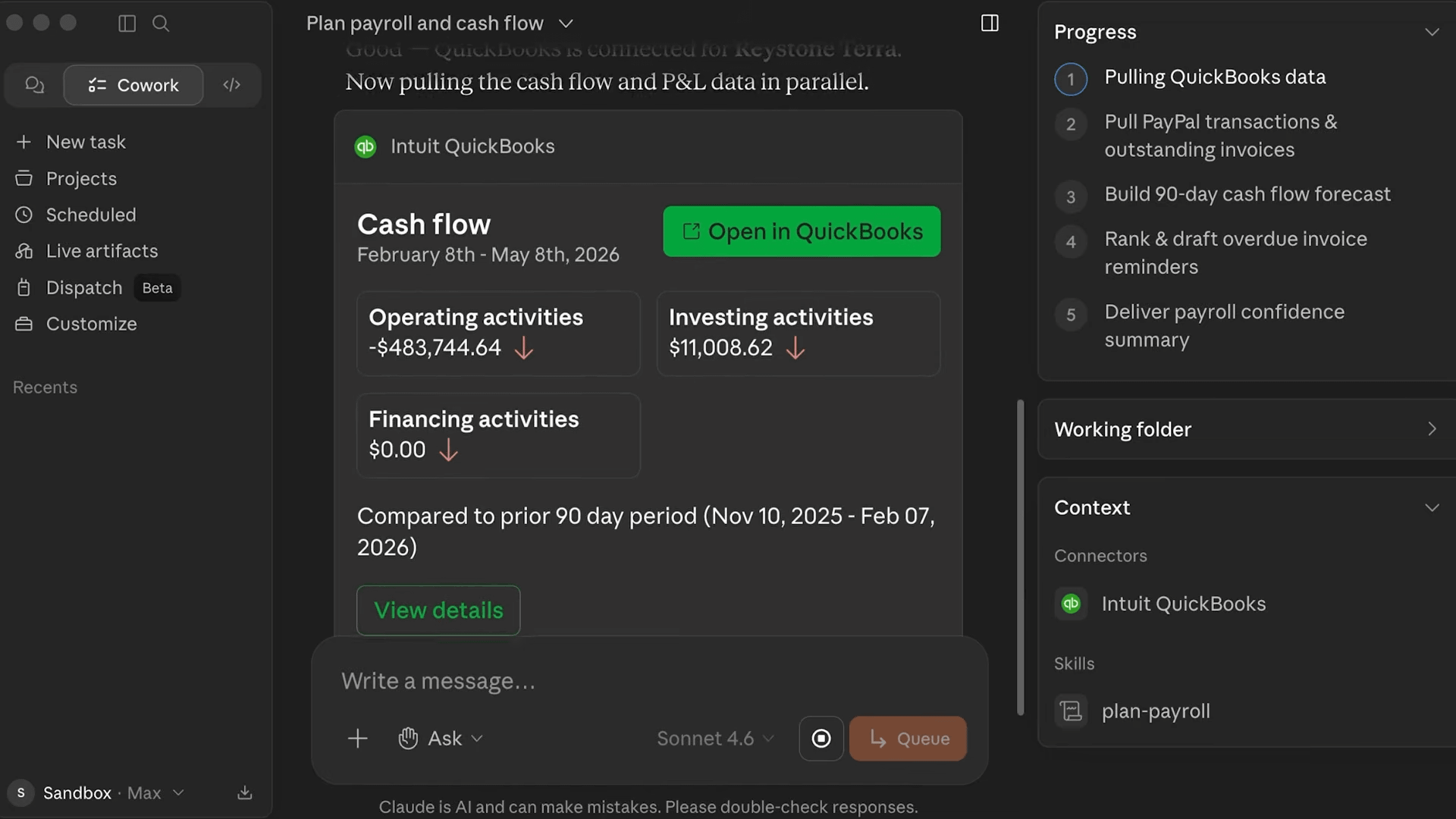
With Claude for Small Business, Anthropic is effectively acting as a wrapper for tools such as QuickBooks, PayPal, HubSpot, Canva, DocuSign, Google Workspace, and Microsoft 365, with Claude Cowork as the interface for running specific workflows or tasks across the stack.
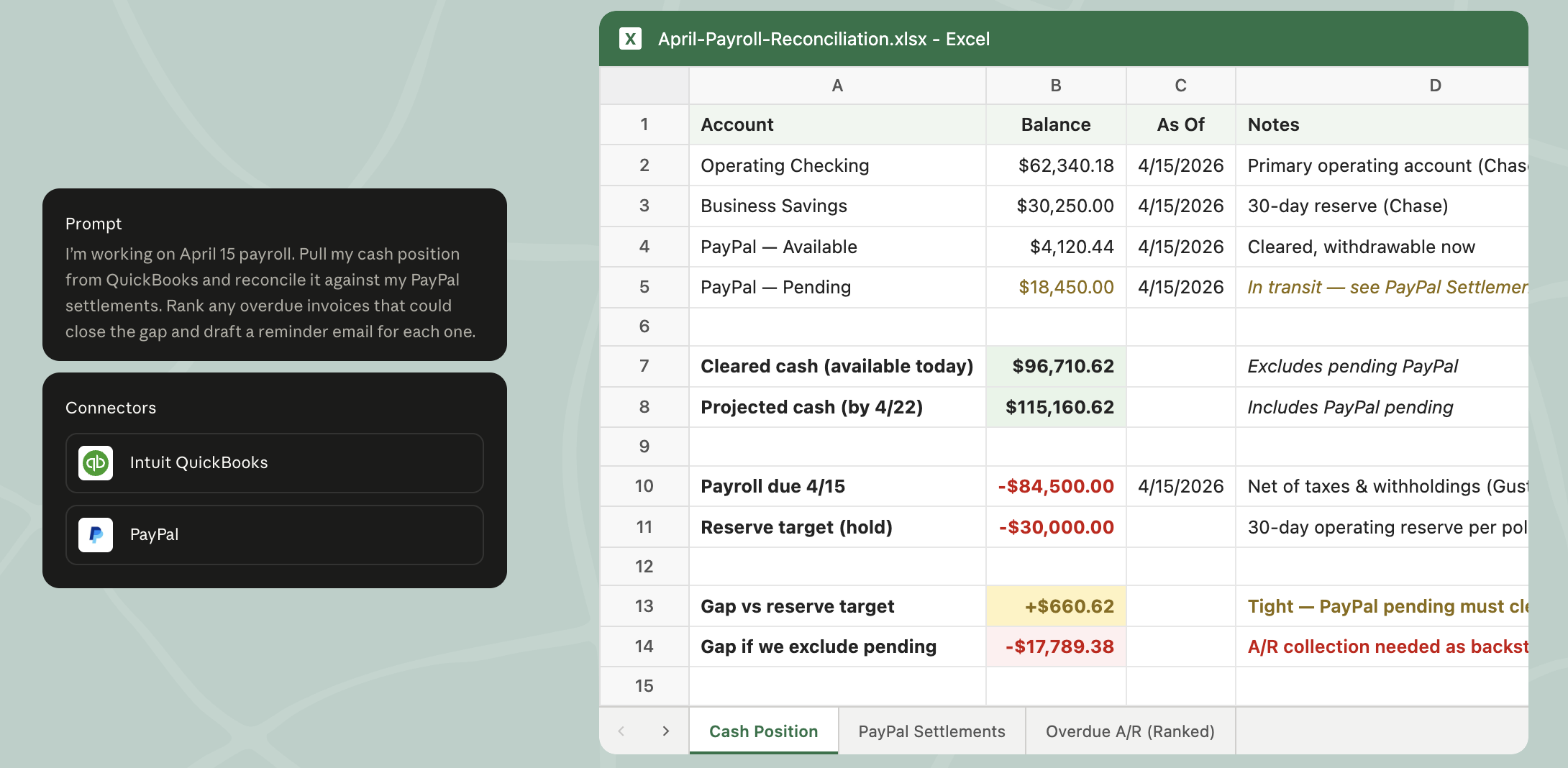
What I find interesting about Claude for Small Business is how it enables Claude to access business data that currently lives across disparate SaaS systems. The more data it can access, the better it can execute common business tasks. Right now, the domain-specific applications and their data sit outside of Claude and I wonder whether that will change. Will Anthropic eventually replace the specialist software systems it currently acts as an interface for? And are SMBs willing to pay both their SaaS vendor and Anthropic?
Anthropic isn’t the only one moving in this direction. Intuit has recently introduced Intuit Assist, an agentic interface that sits across its suite of applications, including QuickBooks and Mailchimp. Rather than letting Claude, Gemini, or ChatGPT become the default interface for small business finance, Intuit is building that layer itself. Ramp, a financial operations platform, has taken a similar approach with its own agentic interface and skills, combining both the application and the interface in one place.
Main learning point: Claude for Small Business is an interesting move by Anthropic: by acting as a workflow layer across the tools SMBs already use, it positions Claude as the interface for running a business, not just answering questions about it. The bigger question for SaaS vendors is whether this is the beginning of AI assistants displacing the front-end of their products. The responses from Intuit and Ramp suggest they’re already taking that threat seriously.
Related links for further learning:

