
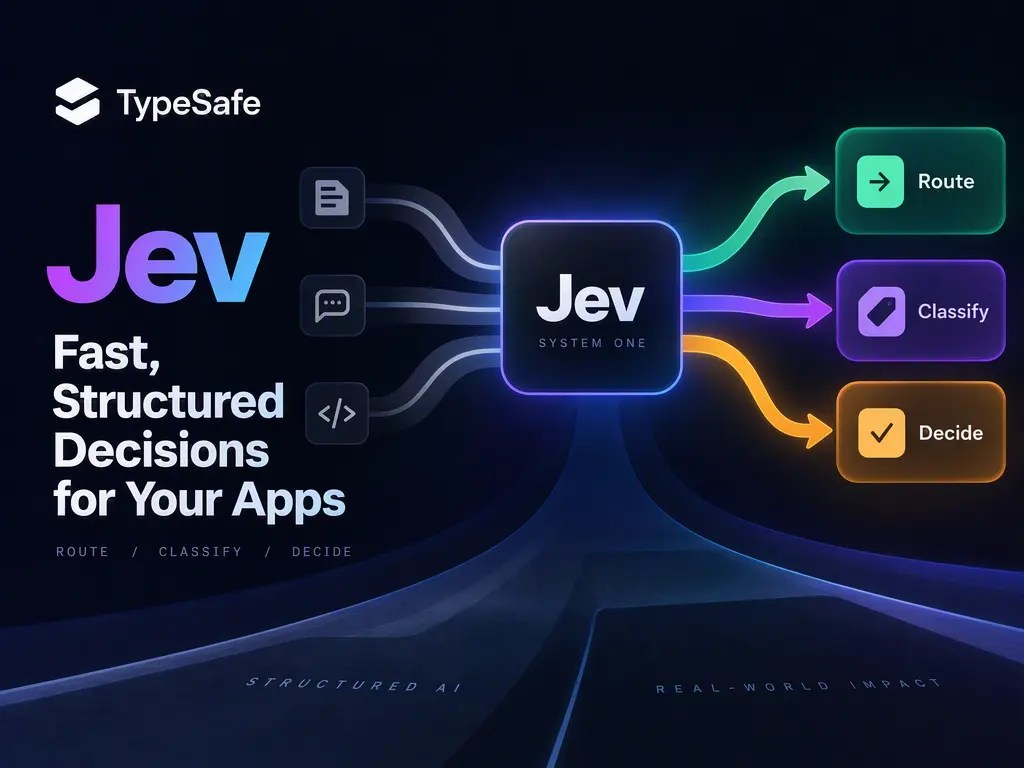
This week I learned about Jev, an AI decision model from TypeSafe AI that’s quite different from the LLMs we’ve grown used to.
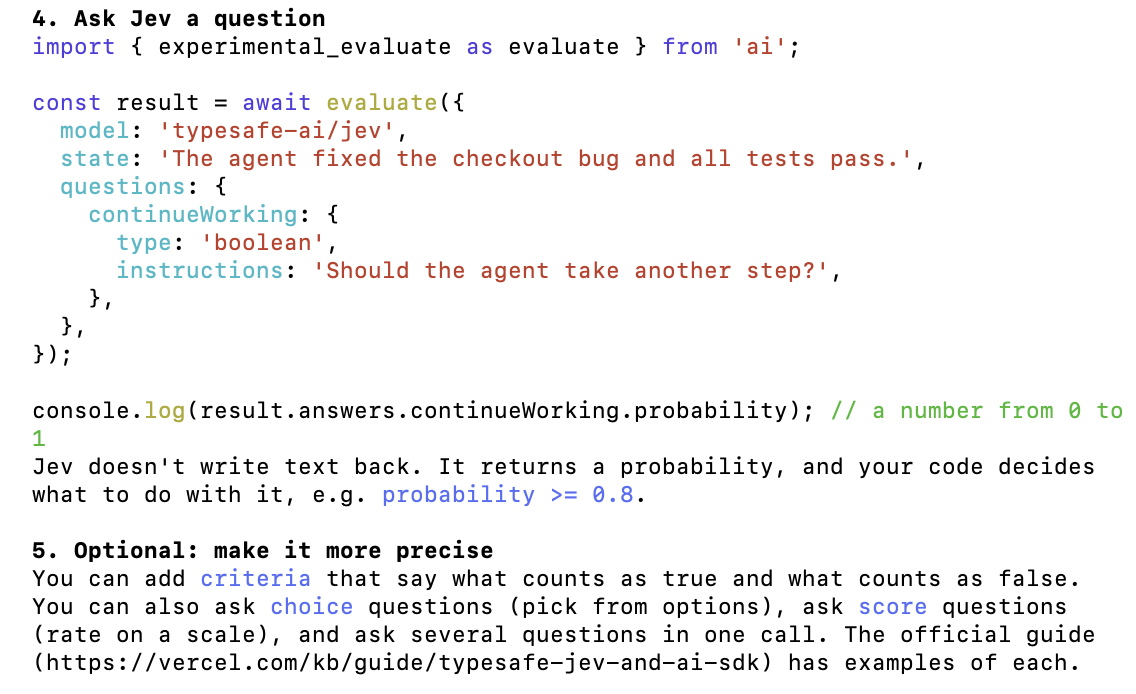
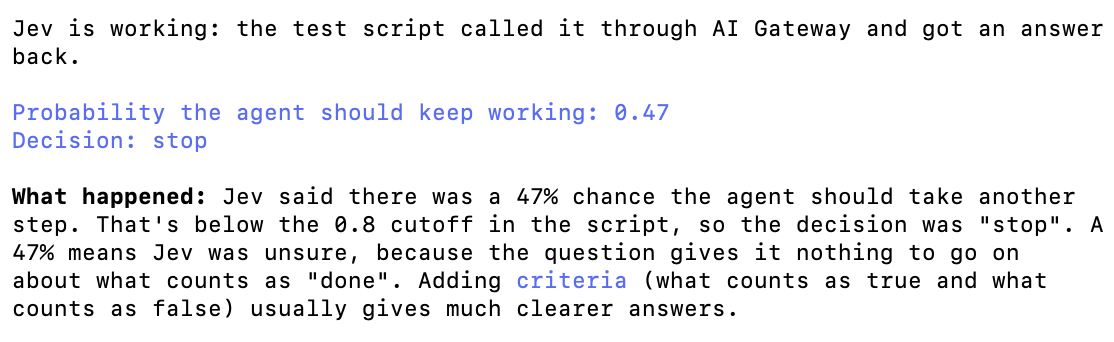
Jev isn’t your standard text-based LLM. It takes an input, applies a schema, and produces an output, similar to a standard API call. The main difference with regular LLMs is that Jev doesn’t return conversational text or do internal reasoning. Instead, it produces probabilistic answers that you can drop directly into code.
Jev supports three question types. Choice selects one option from a predefined list and returns probabilities for each. Score places an input on a defined, ordered scale (like low, medium, high). And Boolean answers a yes-or-no proposition with a probability value between zero and one.
Here’s a concrete example: Jev analysed a customer support ticket about a double-charge and determined it was most likely a high-urgency technical issue (80% probability) from an angry customer (87% probability), routing it to your technical support team with 90% confidence. The model’s high confidence scores suggest it’s quite certain about these classifications.
For example, Jev analysed a customer message and determined it’s most likely a high-urgency technical issue (80% probability) from an angry customer (87% probability), with 90% confidence it should route to your technical support team. The model’s high confidence scores (92-96%) suggest it’s quite certain about these classifications.
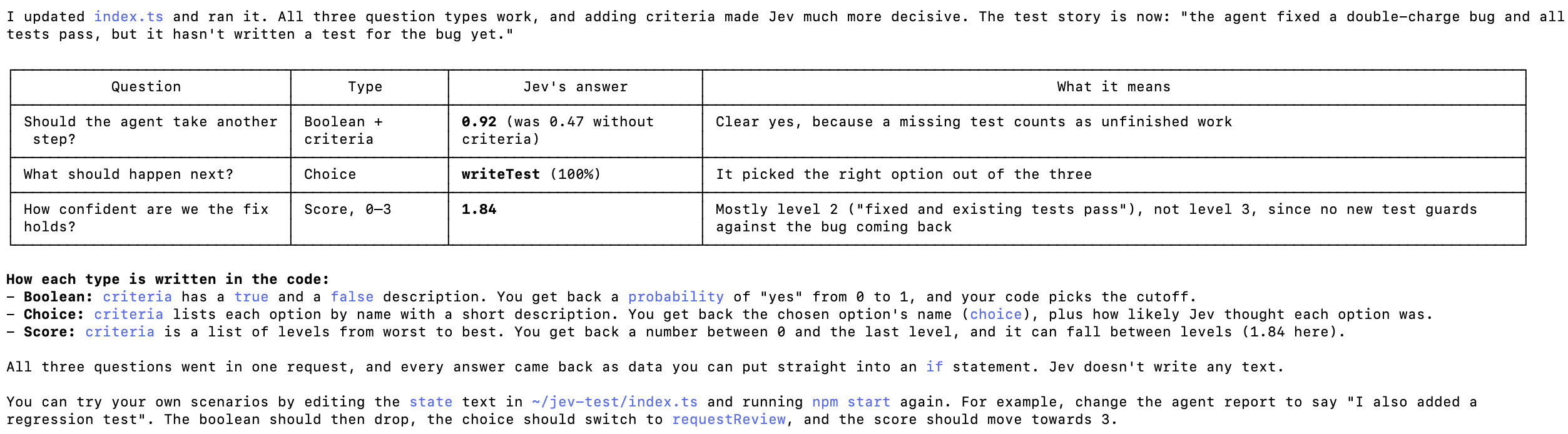
How you write criteria depends on the question type. For Boolean questions, you describe what true and false look like. For Choice questions, you list each option with a short description. For Score questions, you define levels from worst to best, and you get back a number that can fall between levels.
Question: How confident are we the fix holds?
Type: Score, 0–3
Jev’s answer: 1.84
What it means: Mostly level 2 (“fixed and existing tests pass”), not level 3, since no new test guards against the bug coming back
How each type is written in the code:
Boolean: criteria has a true and a false description. You get back a probability of “yes” from 0 to 1, and your code picks the cutoff.
Choice: criteria lists each option by name with a short description. You get back the chosen option’s name (choice), plus how likely Jev thought each option was.
Score: criteria is a list of levels from worst to best. You get back a number between 0 and the last level, and it can fall between levels (1.84 here).
Main learning point: Jev is a fast and cheap alternative to traditional LLMs for decision-heavy tasks. Rather than replacing LLMs, the real power is pairing them. You can use Jev for instant, structured classification that feeds directly into your code, and reserve your LLM for the open-ended reasoning and text generation that actually needs it.
Related links for further learning:
- https://www.mindstudio.ai/blog/jev-use-cases-automation
- https://towardsdatascience.com/jev-vs-llms-when-ai-moves-from-generation-to-decision-making/
- https://medium.com/@unicodeveloper/the-ultimate-guide-to-jev-the-new-frontier-ai-for-faster-decisions-acd78e5f4c56
- https://www.langchain.com/blog/building-a-harness-with-jev

