Last week, shares in Europe’s biggest data, publishing and legal software groups took a hit when Anthropic unveiled a legal productivity plugin. This is an AI-powered productivity plugin for in-house legal teams, automating contract review, NDA triage, legal briefings and template responses. It’s primarily designed for Cowork but also works in Claude Code.
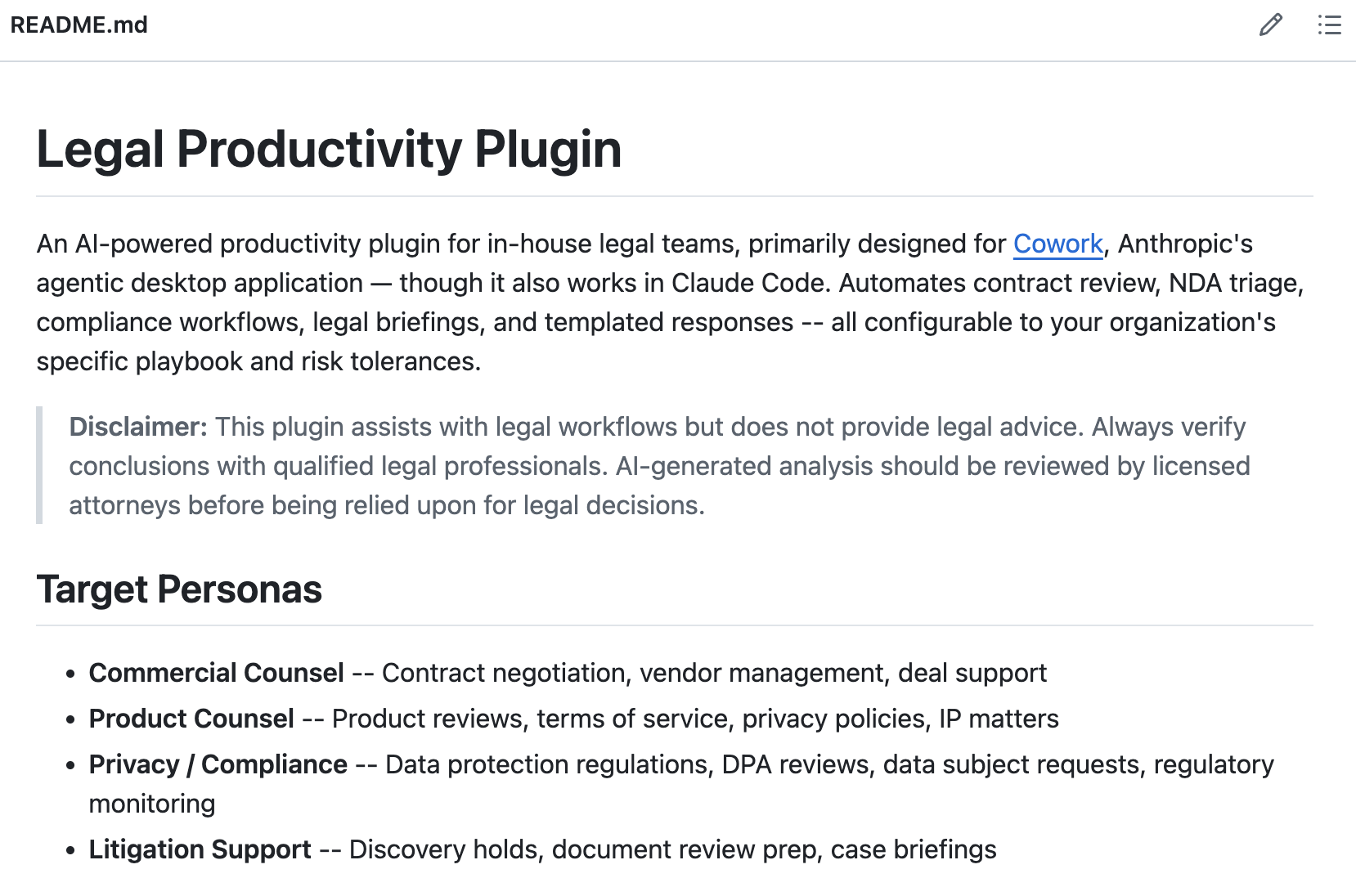
The plugin caters for tasks such as triaging NDAs (classifying them as standard approval, counsel review, or full legal review) or reviewing contracts.
Claude’s agentic workflow for contract reviews consists of the following steps:
Accept the contract – Accepting contracts in set formats (e.g. PDF, DOCX or from a document system). If no contract is provided, the user is prompted to supply one.
Gather context – Asking the user for context before starting the review. Which side are you on? When does the contract need to be finalised? Any specific contractual concerns? Any relevant business context?
Load the playbook – Contracts are reviewed against an organisation’s negotiation playbook, if available in the user’s local settings (e.g. legal.local.md or similar configuration files). The playbook defines the organisation’s standard positions, acceptable ranges and escalation triggers for each major clause type. If no playbook is configured, the user is alerted and alternative options are provided, such as a generic review against commonly used commercial standards.
Clause-by-clause analysis – An outline of key review points per clause (see below), assessed against the playbook (or generic standards), noting whether each is present, absent or unusual.
| Clause Category | Key Review Points |
|---|---|
| Limitation of Liability | Cap amount, carveouts, mutual vs. unilateral, consequential damages |
| Indemnification | Scope, mutual vs. unilateral, cap, IP infringement, data breach |
| IP Ownership | Pre-existing IP, developed IP, work-for-hire, license grants, assignment |
| Data Protection | DPA requirement, processing terms, sub-processors, breach notification, cross-border transfers |
| Confidentiality | Scope, term, carveouts, return/destruction obligations |
| Representations & Warranties | Scope, disclaimers, survival period |
| Term & Termination | Duration, renewal, termination for convenience, termination for cause, wind-down |
| Governing Law & Dispute Resolution | Jurisdiction, venue, arbitration vs. litigation |
| Insurance | Coverage requirements, minimums, evidence of coverage |
| Assignment | Consent requirements, change of control, exceptions |
| Force Majeure | Scope, notification, termination rights |
| Payment Terms | Net terms, late fees, taxes, price escalation |
Flag deviations – Each deviation from the playbook is classified using a three-tier system: green (acceptable), yellow (negotiate) and red (escalate). For example, clauses are flagged “yellow” if they fall outside an organisation’s standard position but remain within a negotiable range.
Generate redline suggestions – When generating redline suggestions, the agent aims to be specific, balanced and prioritised. Each redline suggestion follows a specific format.

With Anthropic providing a legal plugin, it’s the first time that a frontier AI lab has built a legal workflow directly into its platform. Instead of providing an API to legal tech platforms such as Harvey, CoCounsel and Wolters Kluwers, Claude now offers out-of-the-box workflows for common legal tasks.
The approach is still fairly generic, and I believe the real strength of these workflows lies in the extent to which they can be tailored to specific markets, (historic) data sets and negotiation approaches. That said, legal vendors offering generic legal services built on Claude or ChatGPT — effectively offering API wrappers — should be paying close attention. If the platform itself handles 80% of your use case out of the box, the value proposition of a thin wrapper starts to erode quickly.
This release also feeds into a broader concern about the longevity of SaaS. Releases like Claude’s legal plugin, combined with people vibe coding their own versions of existing SaaS products, have fuelled speculation about whether traditional SaaS models are under threat. I personally think it’s too early for those concerns — most enterprise workflows still require deep domain customisation, compliance certifications and integrations that a plugin can’t easily replicate. But the direction of travel is clear: AI frontier labs are starting to package end-to-end experiences for knowledge work tasks such as legal, product management and marketing. The question for existing vendors isn’t whether this shift is happening, but how quickly it will reach their specific niche.
Main learning point: Claude’s legal plugin is a significant signal of where frontier AI labs are heading: from providing infrastructure to delivering complete workflows. For legal tech vendors, the takeaway is clear — differentiation will increasingly come from deep domain expertise, proprietary data and market-specific customisation rather than from wrapping a foundation model in a generic UI.
Related links for further learning:
 As I learn ...