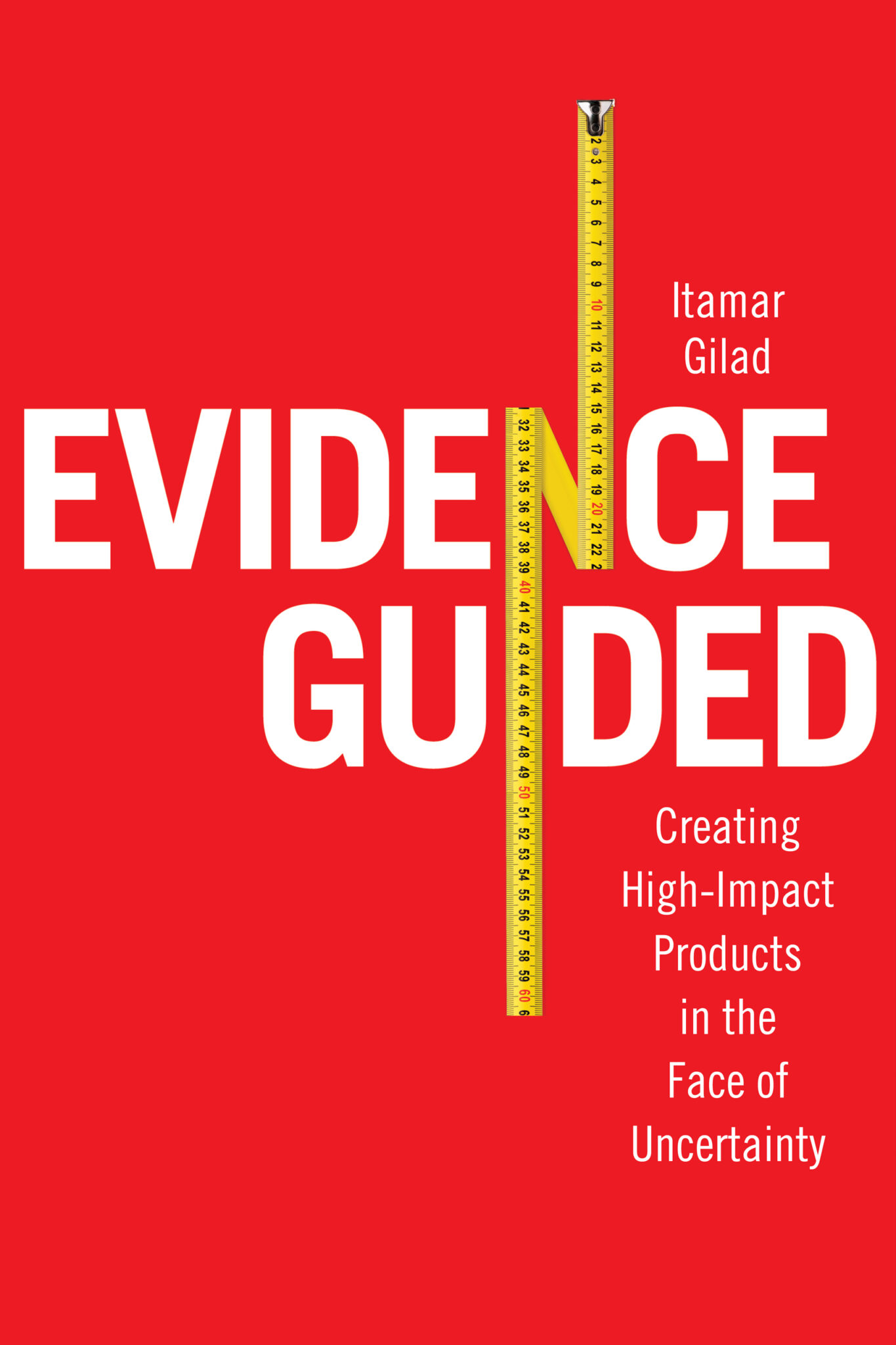
How do you identify the right signals to know you’re tackling the right customer problem? What confidence level do you need to invest in a ‘big bet’? In Evidence Guided, experienced product coach Itamar Gilad describes how to apply evidence-guided development in your organisation.
The book centres around GIST: Goals, Ideas, Steps, and Tasks. Gilad developed this model to help companies take an evidence-guided approach.
- Goals – The outcomes we wish to achieve: measurable benefits for customers and the business.
- Ideas – Potential ways to achieve the goals.
- Steps – Short projects or activities that develop an idea somewhat (often with no coding) and test it.
- Tasks – The work items that go into doing the work.

Using real-life examples, Gilad shares the core process at the heart of GIST: (1) basing ideas on research instead of opinions (2) evaluating the potential of each idea based on data and (3) testing multiple ideas.
Confidence is a key element here, as it measures the evidence supporting an idea. I always try to scope large, risky opportunities based on the confidence level needed to invest in building (and iterating) a product or feature. At times this means you’re not delivering customer or business value straight away, but are de-risking a project early on. Gilad developed the Confidence Meter to help you figure out the level of evidence needed to reach a certain confidence level:

Let’s dive a bit deeper into the different components of Gilad’s GIST framework:
Goals – I’ve often seen people either not think about outcomes at all (feature factories delivering output) or reference high-level business goals only (e.g. “generate more revenue” or “reduce cost”). Gilad describes how evidence-guided companies define firm, measurable goals that state the specific outcomes they want to achieve, but adapt their plans as new information emerges. Having a clear, measurable North Star Metric – the key measure of success for an organisation – helps teams assess the impact of their ideas on business goals. You can use KPI trees to figure out the different factors that ladder up to high-level goals.
Ideas – Especially with the rise of AI prototyping and coding assistants, creating and implementing ideas is becoming easier than ever. As a product person, your role is to ensure the right idea gets picked. The book contains a great quote from the well-known American chemist Linus Pauling: “If you want to have good ideas you must have many ideas. Most of them will be wrong, and what you have to learn is which ones to throw away.” Instead of opinions, we should use evidence to pick the right ideas:
- Evaluate multiple ideas quickly and objectively, using ICE scoring (Impact, Confidence, Ease)
- Pick some ideas to test, using a combination of evidence and judgement to make the prioritisation decision
- Validate the chosen ideas by testing the assumptions embedded in an idea
- Re-evaluate your ideas in light of the evidence you found; park weak ideas and invest in promising ideas instead
- Build and launch when you gain sufficient confidence in an idea, switching from product discovery to product delivery
Confidence asks the question: “How sure are we that the idea will have the expected Impact and the project Ease?” Confidence in an idea stems from supporting evidence – facts, data, and experiment results.
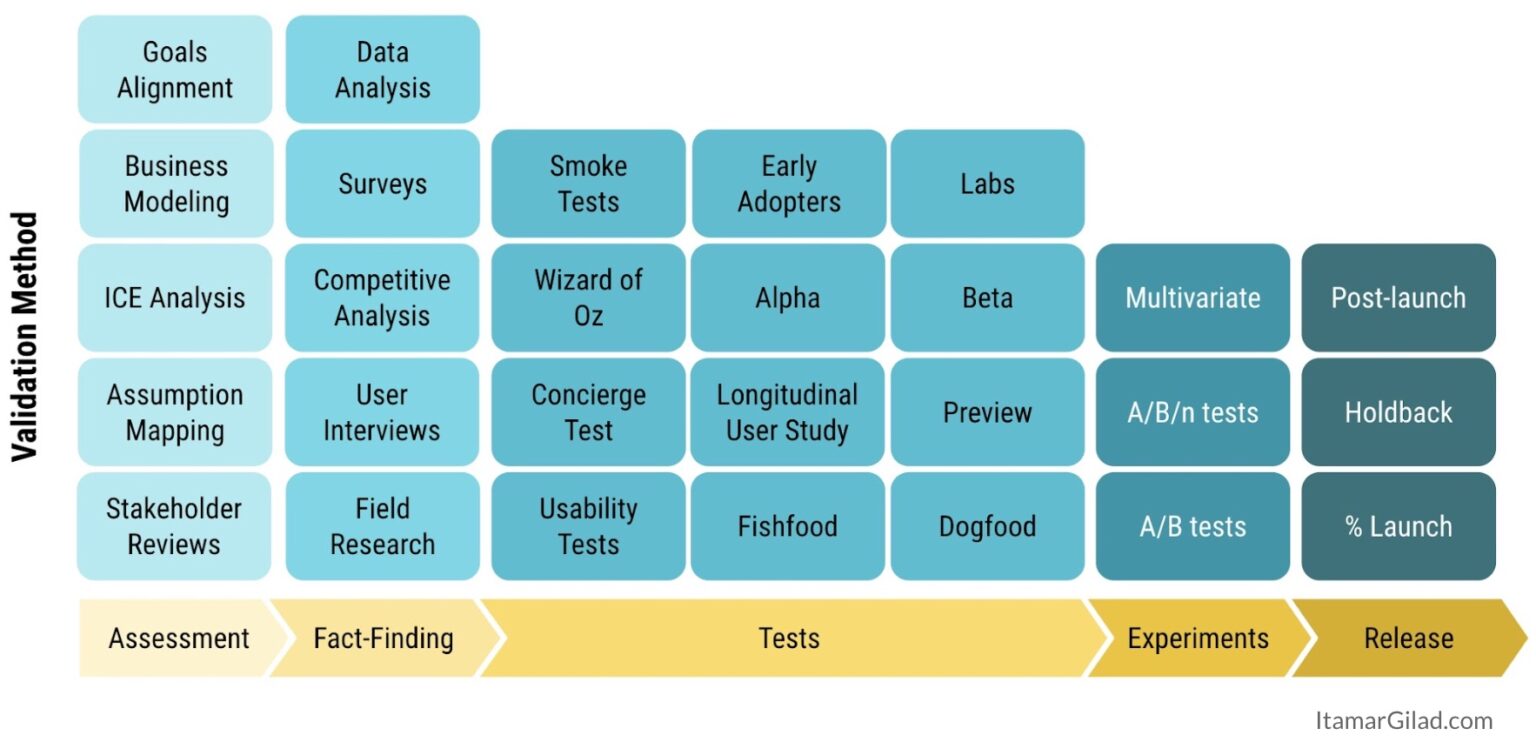
Steps – The steps are the activities we do to validate our assumptions (or refute the risks). Once we know what to test, there’s a wide range of validation tactics we can use. Gilad groups these under the AFTER acronym: Assessment, Fact-Finding, Tests, Experiments, and Release Results.
Tasks – The final layer of GIST is about ensuring your product team is aligned around the actions and decisions needed to achieve goals, find high-impact ideas and test them. The team needs to operate from the same context and be empowered to make decisions within that context. In the book, Gilad introduces the GIST board which teams can use to create shared visibility of what they’re working on.

The structure of the GIST board is pretty straightforward:
- Goals on the left – The outcomes the team is trying to achieve within a certain time frame.
- Ideas in the middle – Only include the ideas you’re working on right now.
- Steps on the right – Typically, you’ll only need 2-4 steps per idea. The team will choose these steps, e.g. starting with data analysis, followed by an A/B test and launch.
A step is successful if at the end of it you have enough evidence to re-evaluate your idea. In other words, each step should lead to higher confidence (in Impact and Ease – see ICE scoring above).
Main learning point: Evidence-guided development isn’t about eliminating intuition – it’s about backing your product decisions with the right level of evidence at each stage. The GIST framework gives you a practical structure to test assumptions early, invest in promising ideas, and kill weak ones before they drain resources.
Related links for further learning:
 As I learn ...