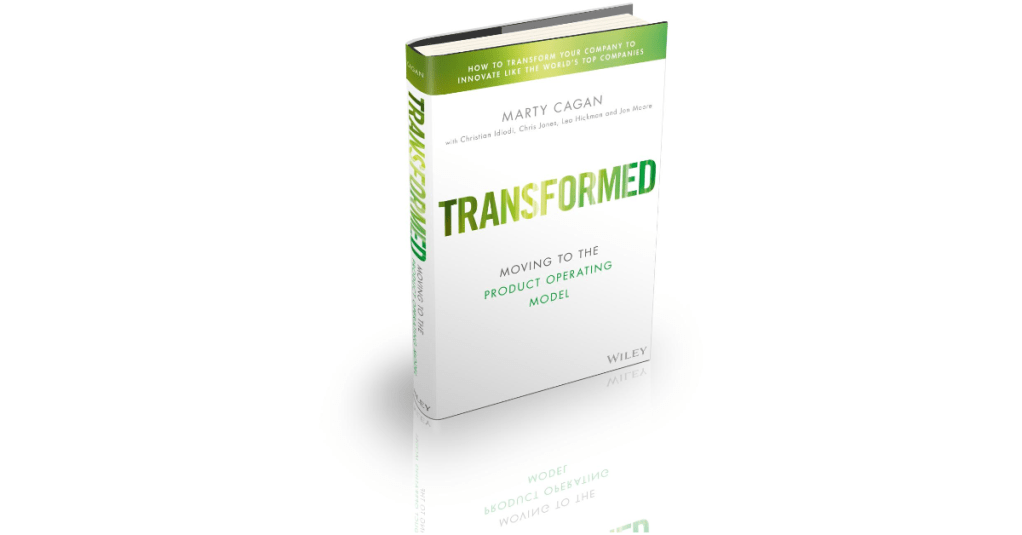
Marty Cagan’s latest book “Transformed: Moving to the Product Operating Model” is about companies wanting to transform so they can take advantage of new opportunities and respond to serious threats. I’m sure many of you have been part of companies going through an ‘Agile transformation’ or are now witnessing ‘AI transformation’. In Transformed, Cagan and his SVPG colleagues frame the product operating model as change along three dimensions:
Changing how you build – I’ve seen companies claiming to be Agile (complete with rituals, guilds and coaches) whilst still only releasing quarterly or monthly. To deliver continuous value to your customers and business, you need to deliver early and often. This means frequent, small releases. It means monitoring your technology to detect problems or usage issues early. And it means proving that new capabilities deliver value before you deploy widely.
Changing how you solve problems – Instead of stakeholders prioritising features for teams to deliver, teams are assigned problems to solve. This means teams having the right context to truly own a specific problem space and outcome. I’ve seen this work well in teams with a strong understanding of customer needs, behavioural data and competitors.
Changing how you decide which problems to solve – Cagan makes the point that strong product companies have a compelling product vision and an insight-based product strategy. The product strategy focuses on the most critical areas for business success and should be insights-based (quantitative and qualitative).
The book describes the competencies required to successfully execute the product operating model. Cagan doubles down on the importance of product discovery: identifying the right problem to solve and finding a solution that’s valuable, usable, feasible and viable. A large part of product management is about de-risking. It’s the responsibility of a cross-functional product team to address four types of risk:
- Value risk – Will the customer buy our solution or choose to use it?
- Viability risk – Will this solution work for our business? Is it something we can effectively and legally market, sell, service, fund, and monetise?
- Usability risk – Can users easily learn, use, and perceive the value of the solution?
- Feasibility risk – Do we know how to build and scale this solution with the staff, time, technology, and data we have?
In a cross-functional product team, these are the critical competencies and what each role is responsible and accountable for:
- The product manager is responsible for value and viability risks and is accountable for achieving the product’s outcomes.
- The product designer is responsible for usability risk and is accountable for the product’s experience – every interaction your users and customers have with your product.
- The tech lead is responsible for feasibility risk and is accountable for the product’s delivery.
Cagan delves deeper into these competencies and provides examples and principles, giving companies a starting point for thinking about transformation.
Main learning point: Product transformation isn’t just about adopting new processes or tools. It means fundamentally changing how you build (delivering frequently), how you solve problems (owning outcomes, not features), and how you decide which problems to solve (using insight-based strategy). This requires moving at speed, using data insights, and partnering across the business. Cagan’s four-risk framework gives product teams a clear structure for de-risking their work, with each role having distinct accountability.
 As I learn ...